
Ever wonder why trees don’t just move in cold weather, or why some plants go dormant (they look dead)? Just like humans and animals, plants have a distinct range of land that they can live and thrive on. But unlike humans and animals, plants have to settle in one place, which means they have to get accustomed to everything that place has to offer. This makes it quite difficult for plants to find a forever home. It’s just like Goldilocks said, some places are too warm, some places are too cold, and some places are just right.
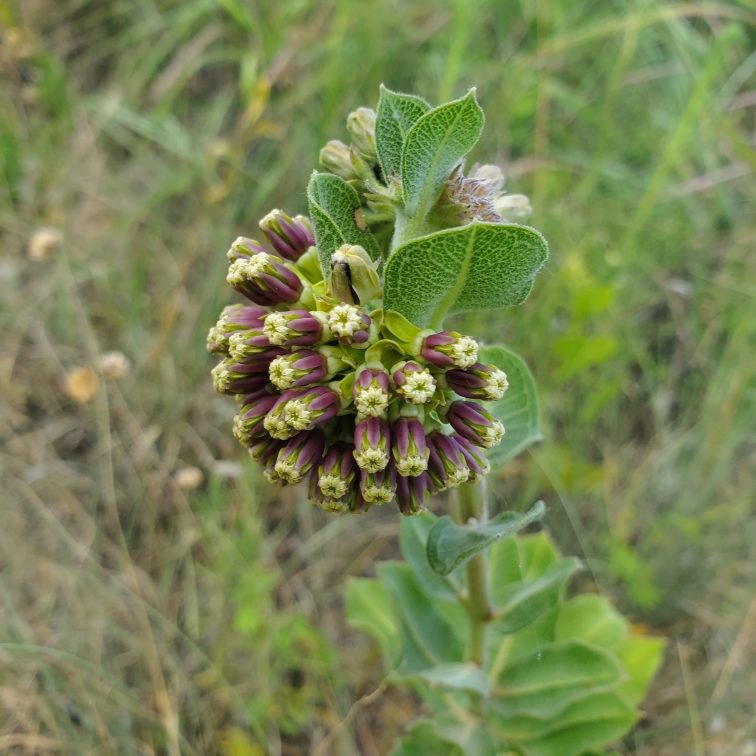
Asclepias viridiflora flowers. Cross Timbers outside Roanoke, Texas. Photo by David Kunkel.
However, even though some places may seem ideal for certain plants, we don’t actually find them there. As global temperatures rise and climate change continues to change our environments, what was once ideal conditions for a plant a few years ago may no longer be the case. This makes finding the ‘ideal’ home as a plant even more difficult and can even put the existence of some plants into danger.
So what does this mean for the future of plants in a changing world? Plant evolutionary ecologist and Ph.D. candidate David Kunkel is working to answer that exact question, “By using historical and present-day information on climate and soil, I can input that into a coding software, which will predict how these environments will change over time.” Kunkel continues, “Coupling that with observations on the occurrence of certain plants at present-day, through herbarium specimens and community-science projects, I can make predictions on what may happen to those species in the future.”
As an evolutionary ecologist, Kunkel studies the relationship between organisms and their environments and how those relationships have changed over time. As climate change becomes even more of a pressing issue for the environment, ecologists have begun to use computer and mathematical techniques to predict how changing climates affect the home ranges of plants across the globe.
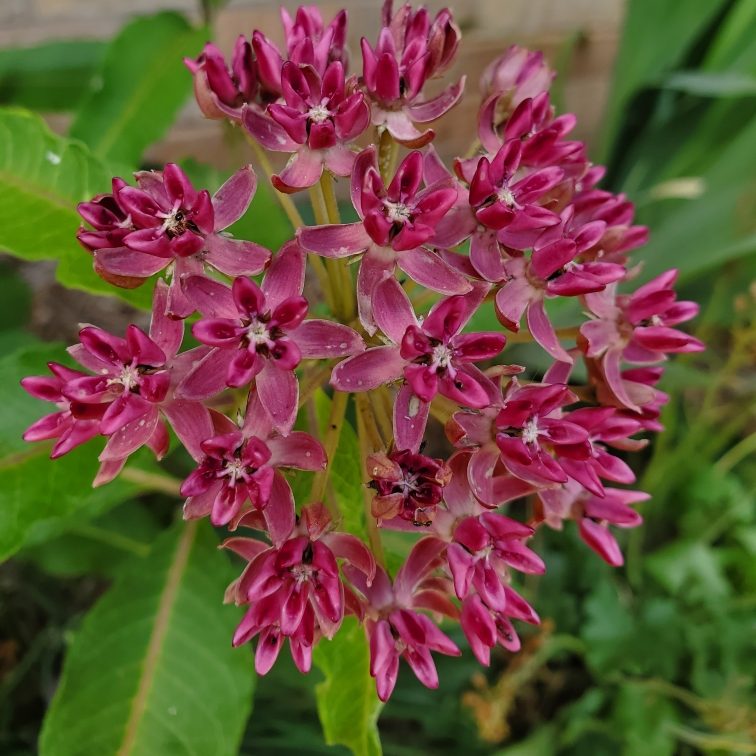
Asclepias purpurascens flowers. Stillwater, Oklahoma. Photo by David Kunkel.
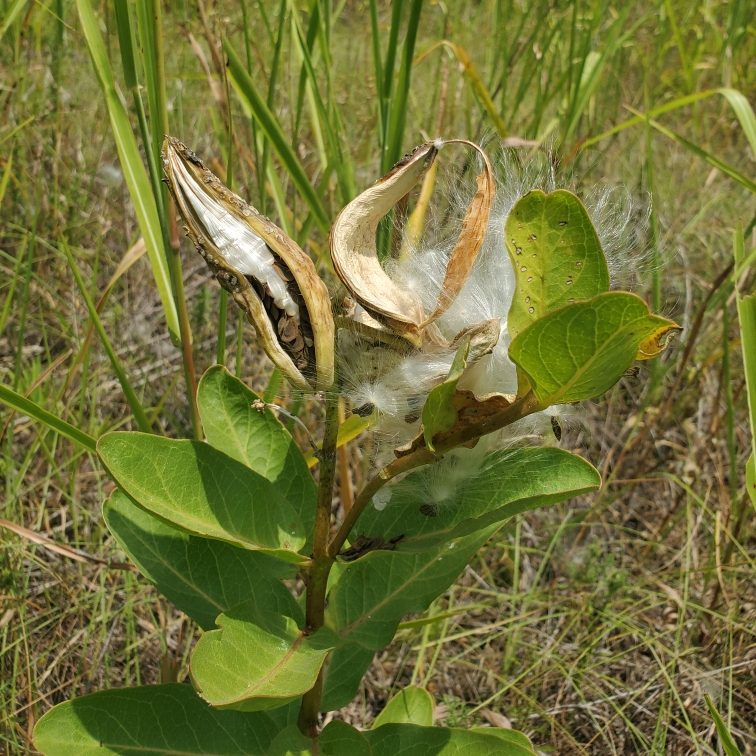
Asclepias viridis fruits and seeds (white fluff). Clear Creek Natural Heritage Center, Denton, Texas. Photo by David Kunkel.
By understanding how plants may be affected by these changes, ecologists can inform habitat restoration projects and provide insight into which areas are in most critical need of protection, to preserve biodiversity.
More specifically, Kunkel and his lab-mates at Oklahoma State University are studying different species (or groups) of milkweed. Milkweeds have recently become popular in the media for their key role in monarch butterfly reproduction, but they are also an important food source for many other pollinators, including wasps and bees. Different species of milkweeds exist in different ranges all over the U.S., which makes understanding their future critical to many pollinators and herbivores that exist in these areas. Kunkel’s work will not only help with conservation efforts of milkweed, but it will help us understand the future of the monarch migration routes which depend on milkweeds.
Even more pressing is that unlike a lot of other plants, milkweeds have a low reproduction rate. “They (milkweeds) can create hundreds of seeds, but the chances of those seeds getting into the ground and making it all the way to the adult stage to continue the population are extremely low,” Kunkel adds, “even in the lab, we typically get less than a 50% success rate, depending on the species, so if their environment is no longer sustainable for them, this puts them in a lot of danger.”
It has become pretty clear that climate change will affect our environment in a myriad of ways, but Kunkel’s work is bringing us one step closer to understanding how the home range of plants may be influenced by this, and what that means for the future of these species. Additionally, Kunkel’s work will provide a framework for other ecologists to utilize to understand how other plants in various habitats may be affected in the future as well.
Want to support my work? Buy me a coffee!
Want my blogs delivered directly to your inbox? Drop your email below and be the first to get notified!
 Gina Errico
Leave a comment